There is a lot of info on the net about building and using a leak down
tester, Harbour freight sells units as do many other automotive supply centers.
Living on a small Island access to stores is limited so I tend to do it
yourself, searching the net I found a few designs of which I show you the basic
how it works here and a photo of my finished unit. This unit seems to work fine
and I have added a link to a youtube video that I have created to show folks how
this simple test works. I created this video as there seemed to be a lot or poor
instructions trhat come with commercial units and misunderstanding on the part
of the home mechanics on how to get meaningful results. so here ya go.
Pretty
simple really, from the right a pressure gauge screwed into a side port of a
standard compressor pressure regulator, you connect your air supply to the quick
connector on the front. The knob on the top is for adjusting the pressure, the
gauge on the right shows you what the pressure regulator is set at (not really
all that relevant). Continuing on from the left of the regulator a pipe runs out
to a small brass fitting that I filled with solder then drilled a 1mm hole in
the center of. This is the restrictor or orifice that allows you to obtain a
pressure differential. Next is a "T" with a pressure gauge, followed by a gate
valve and finally a quick connector that you hook your hose and head adapter to.
I stripped down and welded up an old injector, some folks use a compression
tester adaptor with the check valve removed on gas engines you can adapt an old
spark plug. You could even use an old glow plug I bet. You want to set the
regulator to get a 100 psi reading with the gate valve closed, when you open the
gate valve and pressurize the piston the pressure drop is the percentage of leak
down. See the video below.
Your basic schematic of a leak down tester as built above. This
drawing conveniently snagged off the internet, I would normally give
credit to the author but a number of people have used this drawing and
not given credit to the original source, my apologise.
To put all this testing into context below are the results of the engines
that I have tested with the above tools.
Cold or warm indicates whether I had warmed up the engine prior to testing.
ENGINE 1 N/A DIESEL 540KM (cold)
ENGINE 2 TURBO DIESEL UNKNOWN KM (warm)
ENGINE 3 TURBO DIESEL 200 KM on rebuild
ENGINE 4 TURBO DIESEL Low KM on
rebuild (cold)
COMPRESSION
LEAKDOWN
COMPRESSION
LEAKDOWN
COMPRESSION
LEAKDOWN
COMPRESSION
LEAKDOWN
CYL #1
500 PSI
15%
540 PSI
10%
STAY TUNED
450
25%
CYL # 2
500 PSI
15%
520 PSI
12%
490
15%
CYL #3
500 PSI
15%
540 PSI
10%
450
20%
CYL #4
500 PSI
15%
540PSI
10%
490
10%
COMMENT
A little tired burns oil, runs good
Runs good, smokes a little
Rebuilt recently, runs nice
Rebuilt recently, runs good
Diagnostics
Over all not bad, perhaps
oil seals need replacing to solve the burning oil issue. UPDATE:
Replaced the seals and indeed the blowing blue is gone.
Clearly a little low on one
cylinder. It sounds from the air escaping out the air intake like not
a good seal on the an intake valve on that cylinder. Not serious enough
to do anything at this time, will monitor over time.
Whoa Nelly, two cylinders
down, and air coming out the exhaust valves, perhaps carbon build up or
cracks. You could actually hear the air coming out of the other
cylinders injector holes, due to there exhaust valves being open.
Very revealing.
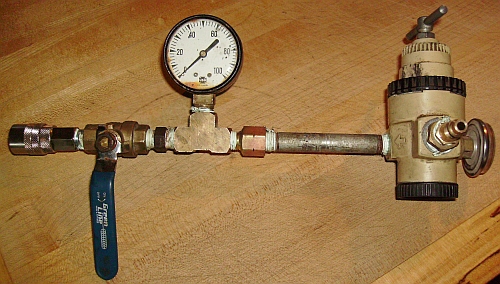 Pretty
simple really, from the right a pressure gauge screwed into a side port of a
standard compressor pressure regulator, you connect your air supply to the quick
connector on the front. The knob on the top is for adjusting the pressure, the
gauge on the right shows you what the pressure regulator is set at (not really
all that relevant). Continuing on from the left of the regulator a pipe runs out
to a small brass fitting that I filled with solder then drilled a 1mm hole in
the center of. This is the restrictor or orifice that allows you to obtain a
pressure differential. Next is a "T" with a pressure gauge, followed by a gate
valve and finally a quick connector that you hook your hose and head adapter to.
I stripped down and welded up an old injector, some folks use a compression
tester adaptor with the check valve removed on gas engines you can adapt an old
spark plug. You could even use an old glow plug I bet. You want to set the
regulator to get a 100 psi reading with the gate valve closed, when you open the
gate valve and pressurize the piston the pressure drop is the percentage of leak
down. See the video below.
Pretty
simple really, from the right a pressure gauge screwed into a side port of a
standard compressor pressure regulator, you connect your air supply to the quick
connector on the front. The knob on the top is for adjusting the pressure, the
gauge on the right shows you what the pressure regulator is set at (not really
all that relevant). Continuing on from the left of the regulator a pipe runs out
to a small brass fitting that I filled with solder then drilled a 1mm hole in
the center of. This is the restrictor or orifice that allows you to obtain a
pressure differential. Next is a "T" with a pressure gauge, followed by a gate
valve and finally a quick connector that you hook your hose and head adapter to.
I stripped down and welded up an old injector, some folks use a compression
tester adaptor with the check valve removed on gas engines you can adapt an old
spark plug. You could even use an old glow plug I bet. You want to set the
regulator to get a 100 psi reading with the gate valve closed, when you open the
gate valve and pressurize the piston the pressure drop is the percentage of leak
down. See the video below.